

Business Talk with Kazuhiro Nomura, Chairman of the Philippine-Japanese Chamber of Commerce and Industry, Director of Mitsui & Co., Ltd., and Manager of the Manila Branch of Mitsui & Co., Ltd., Asia Pacific
Gathering, Amplifying, and Representing the Collective Voice of Japanese Companies:
How The Japanese Chamber of Commerce and Industry of the Philippines, Inc. Is Strengthening Its Policy Advocacy
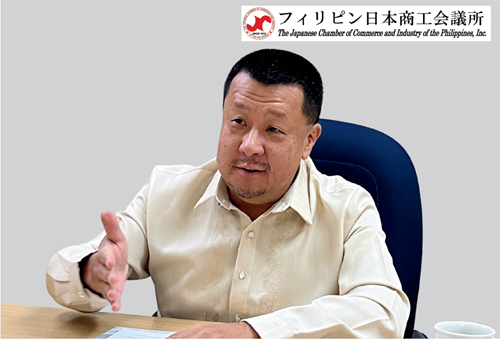
Mr. Kazuhiro Nomura
Chairman, The Japanese Chamber of Commerce and Industry of the Philippines
Director, Mitsui & Co., Ltd.
Mitsui & Co. (Asia Pacific) Pte. Ltd.
Manila Branch Manager
The Japanese Chamber of Commerce and Industry of the Philippines (JCCIP) is currently advancing a major shift toward becoming an organization that proactively puts forward policy recommendations. As issues such as taxation and labor—core pillars of corporate activity—continue to shape the business landscape, the Chamber aims to clearly consolidate and represent the voices of its member companies and translate them into constructive dialogue with the Philippine government .What kind of new framework is being built to support this transformation?
We spoke with Mr. Kazuhiro Nomura, Chairman of the Japanese Chamber of Commerce and Industry of the Philippines and Manila Branch Manager of Mitsui & Co., about the Chamber’s evolving initiatives and its efforts to create an environment where Japanese companies can achieve sustainable growth.
Philippine Primer
It has been six months since you assumed the position of Chairman of the Japanese Chamber of Commerce and Industry of the Philippines. What are your impressions so far, and how do you see the role of the Chamber?
Mr. Nomura
It has been a truly valuable experience. Leading initiatives that shape the business environment for our members in the Philippines is a rewarding responsibility.
The Chamber is essentially a “place where peers come together,” where Japanese companies can share common challenges and concerns. Especially when operating in a foreign country, companies often face similar issues, and having a forum where fellow Japanese businesses can exchange opinions openly and share information is extremely valuable.
Beyond serving as a platform for discussion, however, our role is to accurately grasp the issues raised by our members and, when necessary, work closely with the Japanese Embassy and, together with the Joint Foreign Chambers, engage with the Philippine government to propose concrete improvements. I believe that serving as this bridge is one of our most important missions.
In fact, we are currently in dialogue with various government agencies, including the Department of Trade and Industry (DTI), the Department of Finance (DOF), and the office of Presidential Adviser for Investment and Economic Affairs Frederick Go (at the time of the interview).
One of the Chamber’s key focus areas last year was policy advocacy related to amendments to the CREATE Act. This was a critical operational issue for many Japanese companies, particularly in the manufacturing sector. Working closely with the Japanese Embassy, we made concerted efforts to reflect on-the-ground realities in policy discussions. With the eventual enactment of CREATE MORE, I believe our views were reflected to a certain extent.
Our current focus is Revenue Memorandum Circular (RMC) No. 5-2024, commonly referred to as the digital services tax. As there is a possibility that VAT and withholding tax could be imposed on IT support and consulting services provided by headquarters overseas, we are working together with the Joint Foreign Chambers to develop an “exclusion list.” If implemented, this would be an extremely important initiative that could reduce tax burdens for many foreign companies, particularly across the service sector.
Philippine Primer
What are the current membership trends and challenges facing the Chamber?
Mr. Nomura
At present, the Chamber has approximately 680 member companies. While this represents a recovery toward pre-pandemic levels, it has not yet reached the pre-COVID peak of 694 companies. The industry composition of our membership is also changing. While manufacturing companies still account for roughly 40%, we have recently seen an increase in new members from service industries, retail, and real estate—businesses that are more consumer-facing.
These industries tend to have fewer points of contact with government agencies and may find it harder to perceive the direct value of joining the Chamber. This is precisely why it is important for the Chamber to clearly demonstrate its proactive stance on cross-industry issues such as taxation and foreign employment visas.
However, until recently, the Chamber did not have a dedicated structure for handling policy advocacy.
When we look at chambers in other countries, the American Chamber of Commerce, for example, has highly organized and strategic teams dedicated to government advocacy. European chambers excel in information gathering and analysis, employing intellectual and meticulous approaches that give them overwhelming influence on policy and legislation.
By comparison, our Chamber is still developing in terms of structure. In the past, we largely followed the policy initiatives of other chambers, with very limited independent action. The turning point for changing this approach came with our response to the CREATE Act and CREATE MORE.
Philippine Primer
What measures are being taken to strengthen policy proposal development?
Mr. Nomura
This year, for the first time, the Chamber hired a Filipino staff member dedicated exclusively to policy advocacy. He is an experienced professional who has worked on policy proposals at organizations such as the American Chamber of Commerce and maintains a broad network within government circles. With this hire, I am confident that our policy advocacy capabilities will be significantly strengthened.
While Japanese expatriates typically have limited terms of assignment, making continuity a challenge, we expect this staff member to accumulate institutional knowledge and support sustained activities, enabling us to develop more effective and impactful policy proposals.
In addition, we have formally introduced surveys as a mechanism to capture the voices of our member companies. The first survey focused on tax-related issues and yielded many candid and realistic responses. All surveys are conducted anonymously, with individual company names withheld. The aggregated data will be used to draft position papers for submission to the Bureau of Internal Revenue (BIR) and the DOF. The outcomes of these advocacy efforts will be reported through the Chamber’s official publication, P-Business.
We are also considering future surveys on visa and labor issues. Many practical obstacles—such as the length of time required to obtain visas and restrictions on overseas travel during processing—have been reported to the Chamber. These issues will be addressed not only by the Japanese Chamber alone but also through collaboration with the Joint Foreign Chambers.
Philippine Primer
Do you have a message for Japanese companies operating in the Philippines?
Mr. Nomura
For Japanese companies, the Philippines remains a highly compatible market. Government officials are generally flexible in their approach, and expectations for Japanese technology and investment remain strong. At the same time, challenges persist, such as the lack of continuity due to frequent personnel changes, which can sometimes nullify prior agreements. Issues of corruption are also discussed, but I believe clearer accountability and stronger governance will continue to develop.
As the Philippines evolves, Japanese companies must also respond with flexibility. With our policy advocacy initiatives now gaining momentum, the Chamber’s leadership is fully committed to ensuring that Japanese companies feel their collective voice growing stronger. By sharing common challenges and working together to create a better business environment, I sincerely encourage companies to participate actively in the Chamber’s activities.
Philippine Primer
What initiatives is Mitsui & Co. Asia Pacific pursuing in the Philippines?
Mr. Nomura
Mitsui & Co. has a long history of business in the Philippines, including exports of local resources such as abaca and coconuts, as well as the import of food products and chemicals.
Over the past 30 years, we have also actively engaged in equity participation projects. One representative long-term initiative has been supporting the establishment of Toyota Motor Corporation’s business operations in the Philippines. Around two years ago, we also invested in Metro Pacific, a major local infrastructure and real estate group, marking a full-scale entry into infrastructure-related projects.
Going forward, in addition to our core businesses, we aim to steadily contribute to the Philippines’ development through initiatives in retail, as well as logistics and supply chain development that support these sectors.
About Mr. Kazuhiro Nomura
Born in Kanagawa Prefecture. A returnee who spent his early childhood in the United States and Europe. He graduated from the Faculty of Commerce at Keio University in 1990 and joined Mitsui & Co., Ltd. in the same year. From the outset, he has focused his career on the Information Industry division. His overseas assignments include the United States and Singapore, and in 2023 he was posted to the Philippines in his current role. He assumed the position of Chairman of the Japanese Chamber of Commerce and Industry of the Philippines in April 2025. Married to a Filipina, he volunteered for the assignment. Both in business and in his personal life, he considers the Philippines his “second home.”
Hobby
Traveling. He finds nothing better than relaxing on island beaches. He prefers destinations that are not yet heavily developed, though Boracay remains his top recommendation.
Motto
Not a formal motto, but he believes in always maintaining curiosity, never being satisfied with the status quo, and taking action based on the next interest—something he constantly emphasizes to his staff.
To know more about The Japanese Chamber of Commerce and Industry of the Philippines, Inc., you may visit www.jccipi.com.ph.