

Business Talk with Yutaka Watanabe, Executive Officer, General Manager of Industrial Systems Division, Toshiba Plant Systems Corporation and Masashi Antoku, President, TPSC Philippines Corporation
The “EPCC” Promise Looking Beyond Completion, Toward the Next Decade
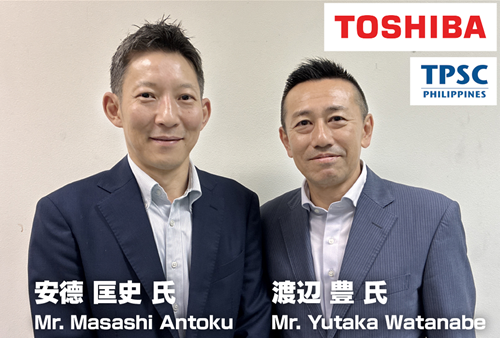
Mr. Yutaka Watanabe
Executive Officer, General Manager, Industrial Systems Division, Toshiba Plant Systems Corporation
Mr. Masashi Antoku
President, TPSC Philippines Corporation
Toshiba Plant Systems and TPSC Philippines have operated in the Philippines since the 1990s, built on the strength of “EPCC”, handling everything from design to construction and commissioning in-house. Ten years after establishing their local subsidiary, the company has continued to meet evolving needs, from power infrastructure to water treatment. We spoke with Mr. Watanabe and Mr. Antoku about the company’s journey and its outlook for the next decade.
Philippine Primer
Please tell us about Toshiba Plant’s business.
Mr. Watanabe
In Japan, we operate in four business areas: nuclear power, thermal power (carbon solutions), general industry, and social infrastructure. Nuclear and thermal power account for roughly half our revenue, with general industry and social infrastructure making up the rest. While classified as a construction company, we are a plant engineering firm handling EPC (Engineering, Procurement, Construction).
We further differentiate ourselves with “EPCC”, adding “C” for commissioning (testing and trial operation adjustment). While some other EPC firms also handle commissioning, we have a dedicated in-house department, allowing us to manage everything from engineering through construction to commissioning internally, taking full responsibility until the completed project meets our customers’ requirements and is handed over.
In the general industry sector, we handle a wide range of work including manufacturing plants, renewable energy, and building facilities. Overseas, we operate mainly in Southeast Asia, the Philippines, Thailand, and Indonesia.
Philippine Primer
What is the history of your business in the Philippines, and what does it look like today?
Mr. Watanabe
Before establishing our local subsidiary, we had already been doing business in the Philippines since the 1990s. At that time, the Philippines suffered frequent scheduled blackouts. Under the IPP (Independent Power Producer) system that allowed private companies to build power plants, we partnered with trading companies to build diesel-engine independent power plants. Since power outages caused enormous losses for facilities like semiconductor plants, many factories maintained their own private generators. We handled diesel-engine private power generation equipment for semiconductor/electronic component manufacturing plants and confectionery factories. As the Philippines’ power situation later improved and stable electricity supply became available, companies shifted toward purchasing power directly from utility companies.
Mr. Antoku
Our local subsidiary was established ten years ago with just six employees, including the president. Back then, with no established management systems in place, we grew through a decade of trial and error, taking on challenges and learning from failures. Today, our Industrial Systems Division handles electrical works for Japanese-affiliated factories, including Toshiba Group plants, as well as automated conveyance system installations to improve production efficiency. We have staff permanently stationed at three locations near our customers’ factories, Laguna, Carmelray, and Batangas, covering everything from maintenance to construction work. We’ve also established a 24-hour system to respond immediately to operator troubles, and our workforce has now grown to 46 employees.
Philippine Primer
What projects stand out most in your memory from the Philippines?
Mr. Watanabe
While working on power equipment for a semiconductor plant equipment that could absolutely never be allowed to stop, I remember the tension throughout the project, and then, upon completion, sharing tears and applause with the customer and local staff in celebration. That sense of unity at the moment a project is completed feels uniquely Filipino to me, and it’s part of what makes this work so rewarding.
Mr. Antoku
One that stands out is the automated conveyance system project for a major Japanese-affiliated factory around the time our local subsidiary was founded. While the factory’s new construction was already underway, we were suddenly asked to install an automated conveyance system (a conveyor spanning about 3.7 km) that hadn’t been part of the original plan. Manual transport would have required too many workers, creating a serious space shortage problem.
Since this equipment wasn’t part of the original plan, we had to determine installation locations within limited available space, and also design an efficient conveyance method. Working with our head office team in Japan, we used 3D laser scanning to plan and diagram installation locations, and designed control systems for branching and merging points, all within the tight time and budget constraints before the factory’s completion. We managed to get the automated conveyance system running at the same time the new factory began operations.
Today, staff remain stationed on-site 24 hours a day, responding to troubles from operator errors. The customer’s comment that “production wouldn’t be possible without this conveyance system” has become a major source of motivation for us.
Philippine Primer
What are your current operations and future plans?
Mr. Watanabe
We are currently focusing on social infrastructure, particularly water treatment projects. The Philippines faces chronic water shortages, driving strong demand for water treatment facilities. We’re working on projects in places like Subic and Batangas on Luzon Island, producing domestic water supply through seawater desalination and sewage reclamation.
In this field, we advance projects in partnership with domestic and international partner companies. Our partners provide the mechanical systems, such as desalination and reclamation equipment while we handle on-site installation, piping, and electrical work, building an integrated system that leverages each party’s specialized strengths.
Even with companies that were once rivals, “co-creation” combining each other’s strengths across company boundaries to generate new value has become increasingly important in recent years. Rather than trying to do everything ourselves, we want to deliver greater value to our customers and society through partnerships with a variety of companies.
Mr. Antoku
When working with Filipino staff, I place importance on respecting their values and thinking things through together, rather than imposing decisions from above. By embracing the culture’s emphasis on family, I feel our local staff are able to perform at their best.
Given its large population and abundant young workforce, I see the Philippines remaining an attractive market for the next 10 to 20 years. We want to contribute to the country’s development by building on our strengths in infrastructure and general industry.
Philippine Primer
A message for our readers?
Mr. Watanabe
True to the Toshiba Group’s slogan “EPCC×VALUE,” we work every day hoping to discover and build value together with our customers, value they may not even recognize themselves. Our ability to flexibly adapt to what customers need is one of our defining traits. Regardless of project size, we believe our strength lies in tailoring our approach to match each customer’s requirements.
Mr. Antoku
For projects our Philippine subsidiary cannot handle alone, we coordinate with our head office in Japan, bringing in engineers from Japan as needed so we can respond as one unified team. While people tend to assume that, as part of the Toshiba Group, we only handle large-scale facility projects, our staff’s average age is young and we’re a nimble, quick-moving company. Please don’t hesitate to reach out to us with any facility-related concerns.
About Mr. Watanabe
Joined Toshiba Plant Construction (now Toshiba Plant Systems) in 1991. Spent about 15 years working on overseas facility construction projects in Africa, Pakistan, and various Southeast Asian countries, later serving as manager and in sales roles before becoming head of technical operations. Went on to serve as head of the Kyushu branch, and is currently an Executive Officer of the company.
About Mr. Antoku
Joined Toshiba Plant Systems in 2005. After working in domestic sales, moved to overseas sales, covering the Philippines from 2010 to 2015 and working on multiple projects. Posted to TPSC Philippines starting October 2025, and currently serves as the comany’s President.
Read More: https://www.toshiba-tpsc.co.jp/english/index.htm